
When Cathrin Pichler’s entire written estate was donated to the Academy of Fine Arts Vienna in 2013, I was asked to participate in building the archive. I first encountered this major collection, when it was still packed into sixty large moving boxes, stacked one on top of the other, containing books, journals, records, and other documents. Following Felicitas Thun-Hohenstein’s initiative to establish an archive, I undertook an initial review and started cataloging together with my colleague Nicole Ziegler. An exciting investigation of this material began with the aim of making it accessible and usable for the public. Space for our work was limited in the first place but the more we unpacked from the boxes became increasingly scarce. We added one piece after another to the database, not knowing whether it was a single piece or whether it belonged to a collection or a specific research theme. Thus, piece by piece, a puzzle was put together that revealed more and more about the person Cathrin Pichler and her pioneering work.
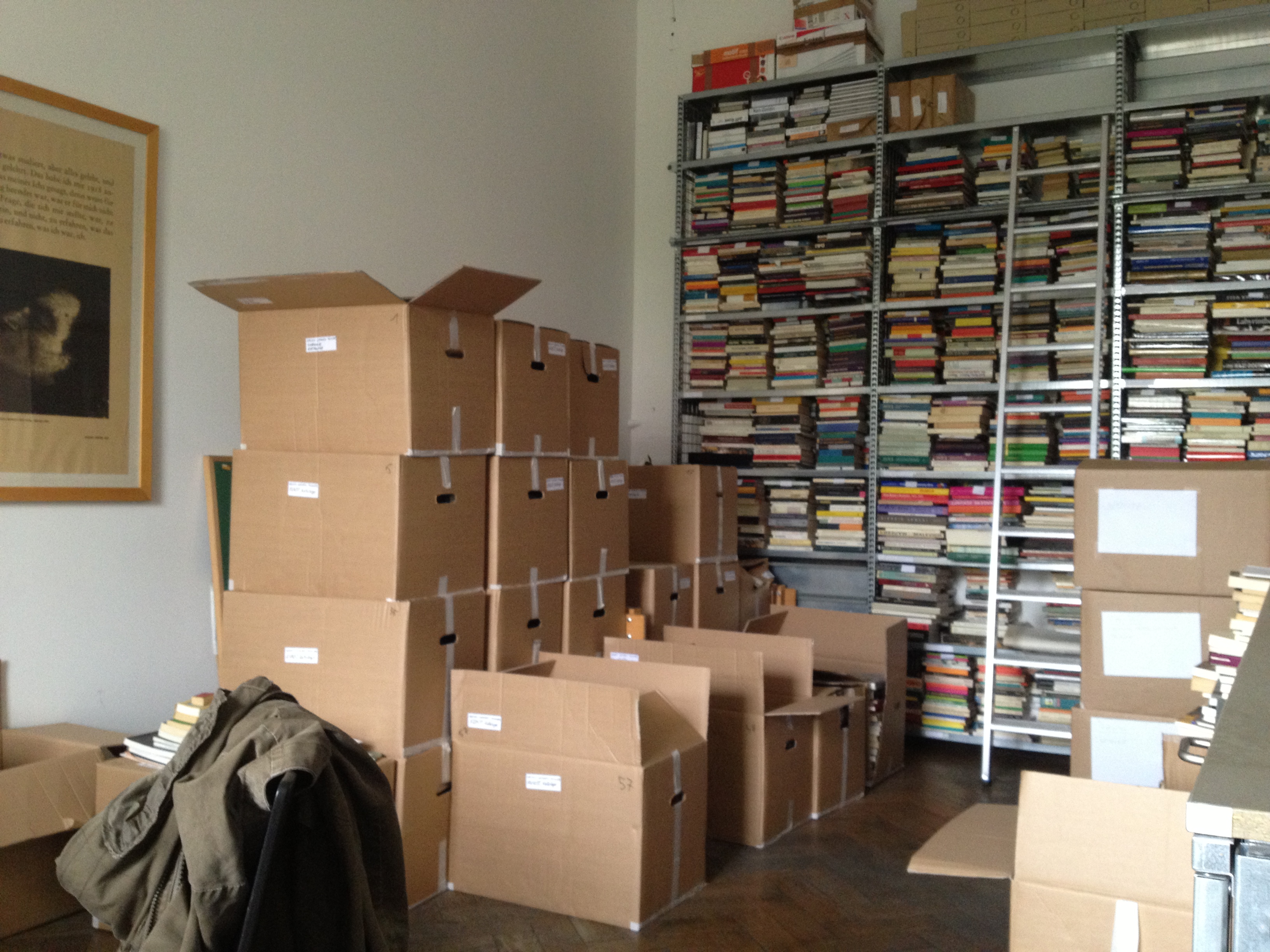
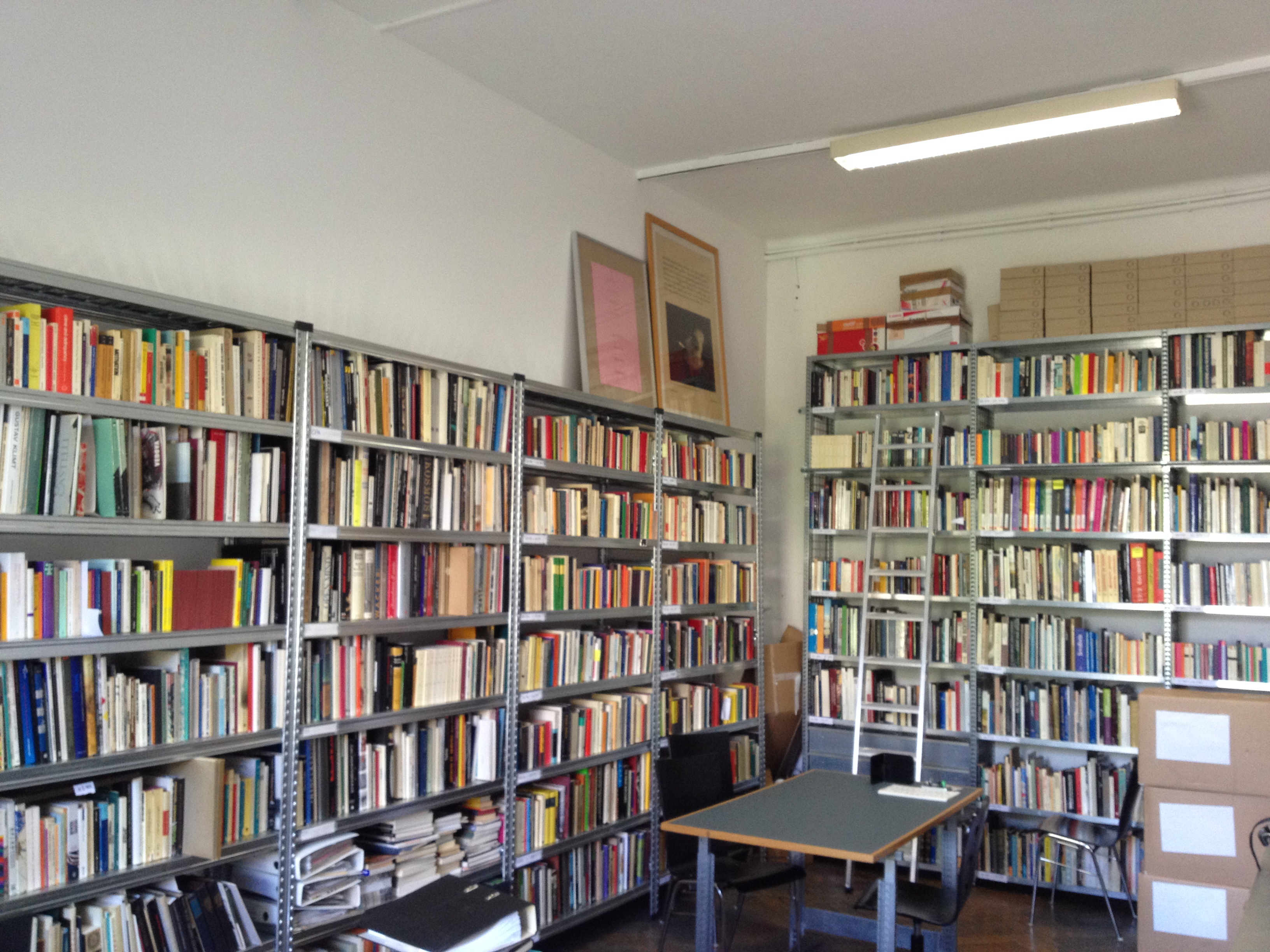
Here you can see the unpacking of boxes at the Academy of Fine Arts in 2014 (picture on the left). After several shelves were added, we were able to categorize and group books but still had boxes waiting to be unpacked in 2015 (picture on the right).
The Cathrin Pichler Archive houses exhibition documentations and publications that testify to an untiring thirst for knowledge and a wealth of ideas.
The archive contains the catalogs of Cathrin Pichler’s exhibitions and other publications in which she was involved as well as research literature across fields. As the collection shows, Cathrin Pichler was a scholar who transcended a single field. The focus of the archive is on art, art theory, and art making, yet we can find a range of works from diverse fields such as medicine, neuroscience, sociology, politics, history. Cathrin Pichler undeniably understood art as a broad concept, illuminated it in heterogeneous contexts, viewed it from variable perspectives, and negotiated it using strategies from different disciplines. She found the appropriate format for this in the exhibition as a form of expression, experiment, place of knowledge, and experiential space. Accompanying publications were more than just documentation: books, catalogs and newspapers were used by Cathrin Pichler as media to expand the content of the exhibition, as part of the exhibition space.
Getting to know Cathrin Pichler as a thinker and curator through her exhibition designs, drafts, documentations and accompanying publications was very exciting and inspiring.
Kunst mit Eigen-Sinn – Aktuelle Kunst von Frauen (Museum des 20. Jahrhunderts Wien, 1985), curated by Silvia Eiblmayr, VALIE EXPORT and Monika Prischl-Maier, was the first major exhibition on which Cathrin Pichler collaborated and it was an important feminist endeavor. She organized a symposium with international guests accompanying the exhibition.
Directly afterwards, Pichler developed and realized, together with Hubert Winter, the exhibition Wien Fluss (1985-1986) at the Vienna Secession and the Theater am Steinhof. Accompanying events took place within the framework of the Wiener Festwochen, and Cathrin Pichler was to realize projects at the Festwochen again and again in the following years.
Later, with the exhibition Wunderblock. A History of the Modern Soul (Wien Museum, 1989), Cathrin Pichler, together with Jean Clair and Wolfgang Pircher, interrogated over two centuries of the history of consciousness and – even more – of the subconscious. Also in cooperation with the Wiener Festwochen, the exhibition took place in the 50th year of Sigmund Freud’s death. Both Freud’s virtuoso exploration of the human psyche and the countless technical inventions of the 19th and early 20th centuries entered into dialogue here with selected works of art. In Pichler’s exhibition Wunderblock, currents in art were thought together with findings from science, such as the theory of evolution, physiognomy, criminal anthropology, memory research, psychology and psychoanalysis, as well as brain research such as the experiments of Jean-Martin Charcot on the Salpetriere.
From now on Cathrin Pichler worked – as it seems tirelessly – on art and cultural projects, exhibitions and catalogs. From 1991 to 1994 she was a program advisory board member of the steirischer herbst festival in Graz. In 1991, the exhibition Sinneswerkzeug. Kunst als Instrument (Art as an Instrument) took place at the Kulturhaus Graz, in which Cathrin Pichler participated, among other things, as editor of the exhibition catalog. In the same year, the Palais Attems hosted her exhibition Semiotexte. Sylvère Lotringer’s publication works, New York 1969-1989. Almost simultaneously with her work at steirischer herbst, Pichler was curator for fine arts at the Federal Ministry for Education and the Arts. In this capacity she conceived and supported over forty projects, including REAL with contributions in Graz, Salzburg and Vienna, the exhibition series REFLEX at the Vienna Secession, Jetztzeit at the Kunsthalle Vienna and Österreich im Rosennetz, curated by Harald Szeemann, at the MAK. Cathrin Pichler was also able to realize projects and establish important contacts abroad, in Belgium, Germany, the Netherlands, Switzerland and the USA. In 1992, Pichler designed the festival program “Expanded Art,” worked on the 300th anniversary of the of the Academy of Fine Arts, Vienna and the exhibition L’Ame au Corps at the Grand Palais Paris.
A particularly characteristic exhibition was certainly :Engel :Engel (Kunsthalle Vienna), in which Pichler dealt with a problem that she repeatedly addressed in her work and activities, namely the unconscious and subconscious, that which is hidden within. Artists represented in the exhibition included Helen Chadwick, Judy Fox, Gilbert & George, Yves Klein, Mona Hatoum, Thomas Ruff, and Kiki Smith.
The search for the unspeakable and invisible, which art addresses, seems to underlie all of Pichler’s exhibitions – exhibitions that can perhaps best be understood as experiential spaces, where it is a matter of possibilities of perception, of what is between the lines, what is hidden from the outside.
But Crossings – Kunst zum Hören und Sehen (1998) was also about the underneath, the hidden, specifically about the role of audiovisual experimentation in art. Crossings was a project Cathrin Pichler realized, this time in collaboration with Edek Bartz, also at the Kunsthalle Wien.
Tracing the invisible and the subconscious, Pichler dealt extensively with the work of Antonin Artaud. For the exhibition Hommage à Antonin Artaud, which was shown at mumok in 2002, Cathrin Pichler compiled the most complex collection of materials by and about Antonin Artaud to date: some 400 originals, some of which had never been shown before, including notes, drawings, sound and film documents. Hommage à Antonin Artaud, curated by Pichler and Hans-Peter Litscher, revealed new insights into the life and thought of the French poet, draftsman, theorist, playwright, director and actor.
Cathrin Pichler was always interested in finding formats beyond the conventional exhibition space.
In 2000, the independent art association museum in progress initiated a protest against the Austrian government, more precisely against the coalition of the Austrian People’s Party (ÖVP) with the right-wing populist Freedom Party of Austria (FPÖ), which participated in the government for the first time. Cathrin Pichler’s project TransAct was a series of exhibitions published in the Austrian daily newspaper Der Standard and composed of contributions from over a hundred international intellectuals, artists, scholars and scientists.
Her last exhibition, The Moderns – Revolutions in Art and Science 1890-1935 (2010-2011, mumok) focused on four interlocking themes: space, dynamics, energy, and chance. The exhibition functioned like an essay and showed art and science in dialogue. A wall newspaper presented scientific developments and formed the exterior of a spiral-shaped spatial construction, the interior of which – significantly – was dedicated to art. Cathrin Pichler was the initiator, project manager, and editor of the exhibition’s publication, which she worked on until immediately before it went to press. Unfortunately, she did not live to see its publication.
The Cathrin Pichler Archive for Art and Sciences at the Academy of Fine Arts Vienna has been open to the public since January 2016 and houses an extensive collection of publications, documentation, and drafts for exhibitions. Pichler’s working method, which runs like a thread through all her projects, seems exemplary for a curator: searching, traveling, collecting, initiating, reflecting, linking, communicating. Exhibition concepts and documentation show how Cathrin Pichler has repeatedly initiated connections and interconnections between individual disciplines, tirelessly searching for new ways of gaining knowledge. Her exhibitions took into account artistic, scientific-technical, political, and social currents. In the juxtaposition and entanglement of art and science, Pichler was particularly interested in those phenomena that take place beyond the surface: the invisible, the unconscious, the inner, the other, the elusive and unspeakable, the soul, the psyche. These themes can be encountered in a wonderful way in the archive.
Art operates playfully and experimentally; it always defies existing boundaries and norms through its tireless and persistent self-reflection. The sciences, on the other hand – and here, of course, especially the natural sciences – investigate and explore with the greatest possible degree of precision on the basis of norms and sets of rules. Spending so much time with Cathrin Pichler’s collection has shown me that while the approaches and methods of art and science are very different from each other, at the same time, seen in dialogue, they enable new perspectives that open up an unexpectedly broad horizon of knowledge.
The first publication of the archive (Schlebrügge Verlag 2018), which I co-edited together with Felicitas Thun-Hohenstein, presents a collection of texts that subject the concept of curating and the role of the curator to a thorough revision—against the background of Cathrin Pichler’s work in the field.
Priglinger, S., Thun-Hohenstein, F. (Eds.) The Curator as… Cathrin Pichler Archiv für Kunst und Wissen-schaften, SCHLEBRÜGGE.EDITOR, Wien, 2018. ISBN: 978-3-903172-03-6
 Sabine Priglinger